
How two total solar eclipses — seven years apart — turned a casual backyard stargazer into someone who really needed to figure out his telescope.
I have never been a particularly well-prepared astronomer. But in the last nine years, I’ve managed to be standing in exactly the right place — twice — when the moon decided to cover the sun entirely. Three minutes and thirty seconds. Both times. That’s all it takes to completely rearrange your priorities.
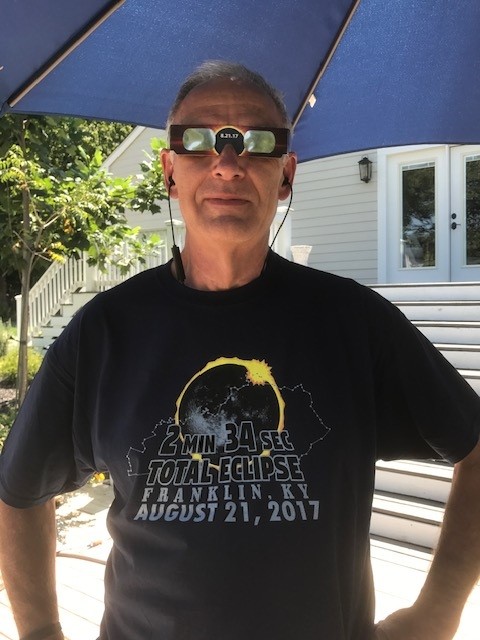
In 2017 my wife and I were living in Franklin, Kentucky — a small farming community about 40 miles south of Nashville. Rural, quiet, the kind of place where the businesses hand out eclipse glasses and folks set up lawn chairs in the parking lot of the hardware store. On August 21st that year, the path of totality passed directly over our little town.
I had my eBay Celestron 8” at the time, but I hadn’t had nearly enough success with it to justify buying a solar filter. So while visitors drove in from all directions to find a good viewing spot, my wife and I took our lunch out to the back porch and just looked up. No telescope. No camera. Just the sky.
It took about an hour to go from full sunshine to what I can only describe as an eclipse version of nighttime — not dark like midnight, but nothing remotely like a sunny afternoon. The temperature dropped noticeably. The light turned strange. Then totality arrived and the world went quiet in a way I wasn’t expecting.
My preacher, who has a small farm nearby, told me afterward that the moment totality hit, every animal on the property — horses, ducks on the pond, all of them — headed straight for the barn or their sleeping spots, exactly as if night had fallen. Three minutes and thirty seconds later, when the sun came back, they came right back out again, calm as could be, as though they’d had a perfectly normal night’s sleep. Creation, it turns out, pays closer attention to the sky than most of us do.
I immediately wanted to see it again.
April 8, 2024 — This Time I’d Be Ready
When I learned that another total eclipse was crossing the region on April 8, 2024, I had one significant advantage over 2017: I now owned my Christmas telescope. [INSERT LINK TO CHRISTMAS TELESCOPES POST] This time, I was going to be prepared. I bought a solar filter for the telescope and a second one for my 300mm camera lens. Then I set everything up in our Murfreesboro yard weeks ahead of time to practice.
Solar alignment turned out to be the one alignment task I could actually manage. Unlike finding a faint star in the dark, the sun is — as I noted to myself — rather easy to find. I practiced tracking it. I worked on camera exposure settings. I even attempted SharpCap for astrophotography. That part didn’t go well, but the camera work did. I felt genuinely ready for the first time in my telescope-owning life.
One unexpected bonus of setting up a telescope pointed at the sun in the front yard: neighbors. Every few minutes someone would slow down, roll down their window, and ask “Whatcha doin’?” I explained the telescope, the filter, the eclipse, and “no, I will not burn my eyeballs.” Secretly, I was just a little nervous about that last part.
West Chester, Ohio — Solo and Ready
The path of totality in 2024 wasn’t crossing Murfreesboro — but our condo in West Chester, Ohio was about 15 miles from a church that was hosting a watch party. Friends we’d made through our daughter were members there and invited us to join them. My wife had a doctor’s appointment that couldn’t be moved, so I made the drive to Ohio alone. If you’ve read the Granddaddy Can’t Cook section, you already know why that detail matters. [INSERT LINK TO CAN’T COOK SECTION]
I arrived at the church as the only person with a telescope. Which meant the northern-accent version of “Whatcha doin’?” started almost immediately. I set up, explained the plan, and opened the eyepiece to anyone who wanted a look.
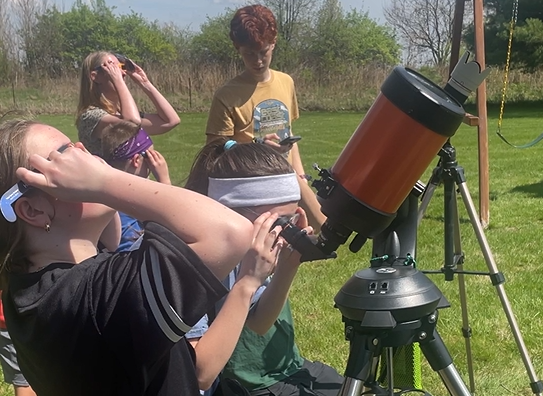
For a couple of hours the kids cycled between playing and checking in at the telescope — “Is it happening yet? No? Okay” — then running back to the playground. It was exactly the kind of afternoon I’d hoped for when I bought the thing.
Totality
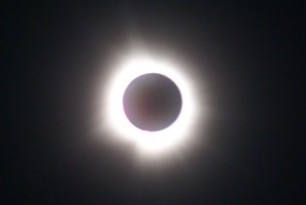
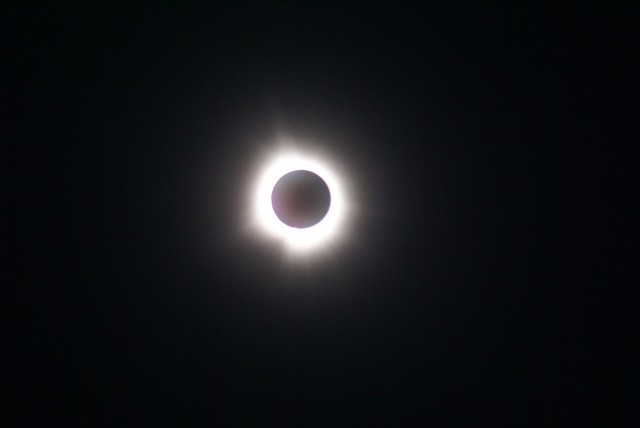
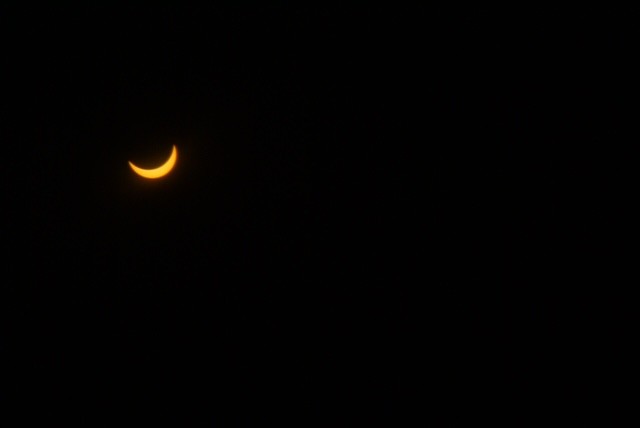
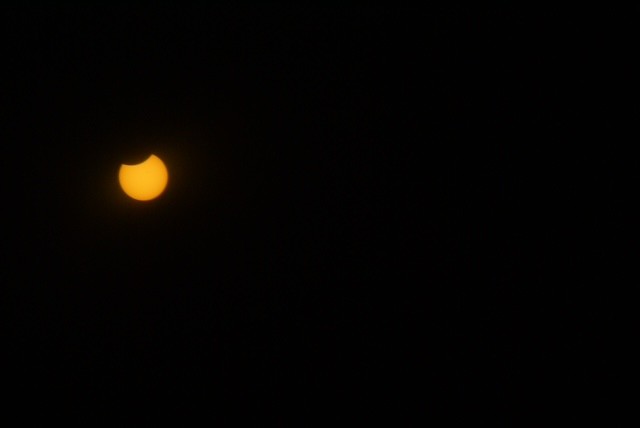
When totality arrived I pulled the solar filters off the telescope and the camera. That moment of removing the filter and pointing the lens at the uncovered sun is one I won’t forget. Either it was going to work or it wasn’t. It worked. Three minutes and thirty seconds of staring straight at the sun for the second time in seven years, this time with a telescope and a camera and a crowd of people taking turns at the eyepiece.
The filtered photos show the sun with an orange cast. The totality photos — no filter, pure black and white — look completely different. I’ll let the pictures speak for themselves.
Then the filters went back on, the sun came back, and about an hour later it was fully over. I packed everything up and drove home. Truly one of the most exciting days of my life.
What I Learned That Afternoon
A solar eclipse is the one astronomical event that comes to you. No alignment, no dark adaptation, no hunting in the dark. Just look up.
- Preparation actually works. Seven years of telescope frustration made the 2024 setup feel almost easy by comparison.
- A telescope in a public place is an invitation. The “can I see?” moments are the whole point.
- The animals had the right instinct. Creation knows when something extraordinary is happening, even if we have to read about it in the news first.
- Three minutes and thirty seconds is not very long. It is long enough to change what you want to do next.
What’s Next
The next eclipse in our area is a ways off. But the telescope is set up, the solar filter is ready, and I now have SharpCap software installed on my laptop — which I am slowly, stubbornly learning to use. The goal is the night sky over my driveway, light pollution, streetlights, and all. I want to see some of the 110 deep-sky objects in the Messier catalog. I want to photograph them with SharpCap and an inexpensive astronomical camera fitted to my telescope. And I want to set up and find everything using the autoguider that came with it. I want to do what amateur astronomers have been checking off lists since 1774.
We’ll get there. And somewhere along the way, I’m still going to photograph Saturn.
Stick with me.
Grace and Peace,
Scott Walker
GranddaddyCant.com
Leave a Reply